

Why Sujawal

THE STRATEGIC CHOICE

Why Sujawal Over Others?

While neighboring districts also face water challenges, Sujawal remains one of the most vulnerable regions due to severe water scarcity, salinity, and limited access to safe drinking water, making it a critical focus for humanitarian water initiatives.

01

The Terminal Point

Unlike Thatta, which sits slightly further upstream, Sujawal is at the absolute tail-end of the Indus River system. By the time water reaches this point, volume is at its lowest and pollutants are at their highest.

02

The "Salt Trap"

While Badin struggles with coastal flooding, Sujawal suffers from intense seawater intrusion. Because the river flow is often too weak to push back the ocean, the groundwater has become exceptionally saline—far beyond the tolerance levels of standard filtration systems.

03

Clean Water Crisis

Limited access to clean water contributes to widespread health issues, malnutrition, and reduced quality of life across vulnerable communities.

The Real Crisis

Life at the Edge

The people of Sujawal are living through a constant water crisis driven by three major challenges:

Severe Water Shortage

As the final stretch of the Indus River system, Sujawal faces extreme freshwater shortages, especially during dry seasons when river flow fails to reach local communities.

Dangerous Salinity

Seawater intrusion has made much of the groundwater highly saline and unsafe for drinking, contributing to serious health issues including kidney problems and skin diseases.

Livelihood Collapse

Salt-contaminated water is damaging agriculture and livestock, leaving many families struggling with poverty, unemployment, and displacement.

OUR SOLUTION

Engineering Resilient Water Access

We are not just providing water — we are building long-term, sustainable access to clean drinking water for vulnerable communities in Sujawal.

  • Climate-Resilient Systems: Implementing water solutions designed to operate effectively in Sujawal’s high-salinity environment.
  • Solar-Powered Access: Using solar energy to provide reliable water access in remote areas with limited electricity.
  • Durable Infrastructure: Building long-lasting systems with materials suited for harsh coastal conditions.
  • THE GOAL: By solving the water crisis in Sujawal, we establish a "Gold Standard" for all of Sindh. We prove that even at the edge of the world, clean water is possible.

OUR GOAL: By addressing Sujawal’s water crisis, For Humanity aims to create scalable and sustainable clean water solutions that can support vulnerable communities across Sindh.

Reducing Climate Displacement

Water scarcity in Sujawal is forcing many families to migrate in search of basic necessities. By improving access to clean water, For Humanity aims to support vulnerable communities and reduce climate-driven displacement.

Severe Water Stress

Declining freshwater and seawater intrusion have made safe drinking water increasingly difficult to access in Sujawal. Sustainable water solutions are essential for protecting public health and strengthening community resilience.

Protecting Livelihoods

Sujawal remains an important agricultural and livestock region, but limited freshwater continues to threaten local livelihoods. Improving water access can help support farming communities and strengthen economic stability.

Summary

Sujawal is at the frontline of Sindh’s water crisis. For Humanity is committed to providing sustainable water solutions that protect communities, livelihoods, and long-term resilience.

Feature Sujawal Interior Sindh
(e.g., Larkana)
Water Table High
(but very salty)
Deep
(but often fresher)
Sea Threat Immediate
(Seawater intrusion)
None
Primary Need Desalination & Purification Extraction & Distribution
Urgency Critical
(Risk of land loss)
High
(Resource Mgmt)

Why Clean Water Is Essential in Sujawal

In Sujawal, clean water is essential for survival, health, and stability. Severe water scarcity and rising salinity have left many communities without safe drinking water, impacting public health, livelihoods, and long-term community resilience.

Preventing "Climate Migration"

Sujawal is currently one of the largest sources of internal displacement in Pakistan.

  • The Cycle: When a local well turns salty or a canal stays dry for more than one season, families have no choice but to abandon their ancestral homes.
  • The Result: Without a reliable water source, entire communities migrate to the slums of Karachi or Hyderabad.
Combatting the Health Crisis

People are forced to drink seepage water or stagnant pond water shared with animals.

  • Disease Prevention: Water is necessary to stop the spread of cholera, dysentery, and hepatitis.
  • Arsenic Mitigation: Filtered, arsenic-free water prevents long-term organ damage and skin diseases.

Sustaining the Livestock Economy

Sujawal is famous for its cattle and buffaloes.

  • Survival of Assets: For a farmer, a buffalo is his entire savings account.
  • The Crisis: Heatwaves kill livestock because they cannot drink highly saline water.

Stopping Seawater Intrusion

Freshwater is needed not just to drink, but to push back the ocean.

  • Environmental Shield: Canal flow creates pressure that prevents seawater intrusion.
  • Soil Health: Without freshwater, land becomes poisoned by salt.

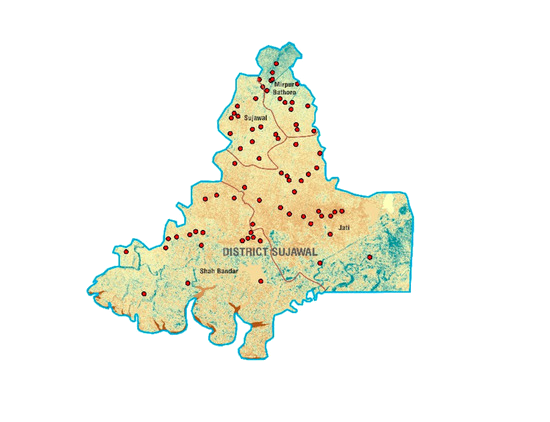
Sujawal is 129 km from Karachi

01 Step

Nearby cities: Thatta, Mirpur Bathoro, Jati, Badin

02 Step

Known as a fertile agricultural and cultural hub near the Indus Delta

03 Step
Sujawal Map
04 Step

Faces severe climate risks and long-term neglect

05 Step

UNICEF reports 72% child stunting due to poor access to nutrition

06 Step

Salty subsoil water causes skin and digestive health problems

Procedure of Borehole?

Phase 1: Pre-Drilling Assessment

Before any machinery arrives, two critical steps are necessary to avoid wasting money on a "salty well."

  • Geophysical Survey: A resistivity survey is conducted using specialized sensors to map the underground layers. This helps identify "freshwater lenses" (pockets of sweet water) versus saline aquifers.
  • Site Selection: The borehole must be located at least 30–50 meters away from latrines, animal pens, or stagnant ponds to prevent biological contamination.

Phase 2: The Drilling Process

In Sujawal’s soft, alluvial soil, Direct Mud Rotary Drilling is the most common method used.

  • Setting Up: The drilling rig is stabilized. A "mud pit" is dug nearby to circulate drilling fluid (bentonite), which cools the drill bit and keeps the hole from collapsing.
  • Penetration: The drill bit descends. In Sujawal, teams usually aim for depths between 150 to 300 feet to bypass surface pollution, though this varies based on the survey.
  • Logging: As the drill progresses, the geologist inspects the "cuttings" (sand and clay samples) to confirm they have hit a water-bearing layer (aquifer).

Phase 3: Well Construction

Once the hole is drilled to the desired depth, the "skeleton" of the well is installed.

  • Casing: PVC pipes (usually 4–6 inches in diameter) are lowered into the hole to prevent it from caving in.
  • The Screen: At the bottom, a "slotted" pipe (the screen) is placed. This allows water to enter the pipe while keeping sand and grit out.
  • Gravel Packing: The space between the PVC pipe and the earth is filled with graded pea gravel. This acts as a natural primary filter.
  • Sanitary Seal: The top 10–20 feet are sealed with cement (grouting) to prevent dirty surface water from leaking down into the well.

Phase 4: Development and Testing

This is the most important phase for the people of Sujawal.

  • Flushing: High-pressure air or water is used to clean the well until the water comes out crystal clear.
  • Yield Testing: The well is pumped for several hours to see how much water it can provide without running dry.
  • Water Quality Analysis: Crucial Step. A sample is sent to a lab to test for:
  • TDS (Total Dissolved Solids): To check for salt.
  • Arsenic Levels: To ensure it is safe for human consumption.
  • Bacterial Count: To check for E. coli or Cholera.

Phase 5: Completion

  • Pump Installation: Based on the depth, either a manual hand pump or a solar-powered submersible pump is installed.
  • Platform Construction: A concrete "apron" or platform is built around the wellhead to ensure spilled water drains away and doesn't create a muddy, diseased pool.

Standard Requirements (Sujawal)

  • Drilling Method: Mud Rotary (due to sandy/silty soil)
  • Average Depth: 150 - 400 feet (varies by village)
  • Casing Material: Class-D PVC (Corrosion resistant)
  • Required Testing: Arsenic, Salinity, and Bacteria
Sujawal’s increasing water demand

A Note on Sujawal’s Soil

Sujawal’s soil contains a high concentration of fine sand, making proper filtration essential for long-term water system performance. Installing high-quality sand filters and protective screening helps prevent pump damage, reduces maintenance issues, and improves the durability of community water infrastructure.

Sustainable Water Infrastructure Plan

The future of water solutions in Sujawal lies in building sustainable, resilient, and community-focused infrastructure. Modern water systems are evolving beyond basic supply points into reliable solutions designed for long-term impact, environmental responsibility, and efficient operation.

Our Future Water Sustainability Roadmap

This roadmap outlines For Humanity’s long-term vision for sustainable water solutions in Sujawal, beginning with community water pumps and expanding toward advanced water purification systems in the future.

01

Transition to 100% Solar-Grid Hybrids

The biggest failure of past RO projects in Sujawal was the high cost of electricity and frequent power cuts.

  • The Plan: All future RO plants are being designed with integrated solar arrays.
  • Battery Storage: New designs include lithium-ion or sodium-sulfur battery storage to allow the plants to operate during the night or during Sujawal’s frequent monsoon cloud cover.
  • Result: This eliminates the "operational cost" that previously forced many plants to shut down when communities couldn't pay the electricity bills.
02

Smart Monitoring & IoT Integration

In the past, an RO plant in a remote Sujawal village could be broken for months before anyone in the city knew.

  • The Plan: Implementation of Internet of Things (IoT) sensors on every unit.
  • Real-time Data: These sensors monitor water flow, TDS (salt levels), and membrane pressure.
  • Predictive Maintenance: If a filter is clogging or a pump is overheating, an automated alert is sent to a central maintenance hub in Sujawal city or Thatta, allowing technicians to fix it before it breaks.
03

Brine Management and "Salt Farming"

A major environmental concern with RO is the "brine" (the super-salty waste water) it produces. In the past, this was dumped back into the soil, damaging the land.

  • The Plan: Moving toward Zero Liquid Discharge (ZLD) systems.
  • Evaporation Ponds: Future plants will include lined evaporation ponds where the brine is dried out to collect industrial-grade salt.
  • Halophytic Agriculture: Using the salty waste water to grow "salt-loving" plants (like certain types of fodder or mangroves) instead of letting it ruin fertile soil.
04

Mineral Re-Injection Technology

Early RO plants in Sindh often stripped all minerals from the water, leaving it "dead" and potentially causing mineral deficiencies in children.

  • The Plan: Future RO units are equipped with re-mineralization cartridges.
  • Health Focus: These systems add back essential levels of calcium, magnesium, and potassium, ensuring the water isn't just "wet," but nutritionally beneficial for the local population.
05

Community-Owned "Water ATM" Models

To ensure long-term survival, the management model is changing from government-run to community-managed.

  • The Plan: The "Water ATM" system. Residents are given a prepaid chip card.
  • Sustainability: They pay a very small, subsidized fee (e.g., 5–10 rupees per 20 liters).
  • Local Employment: This revenue stays in the village to pay for a local operator and a security guard, making the plant self-sufficient.

Contact Us

Commercial :

+ ### ### ###

Donation :

+ ### ### ###

Drop a Line

Information :

info@forhumanity.life

Agency :

reserve@forhumanity.life